There is a famous controversy between St. Thomas Aquinas and Bl. John Duns Scotus on the question of whether God would have still become man, if man had not sinned/fallen. Bl. Scotus says yes, for reasons having to do with his theory of the Primacy of Christ; St. Thomas gives a cautious “no,” because he says we can only know God’s intentions from revelation, and revelation seems to indicate that God became man in order to save man from sin (see ST 3.1.3).
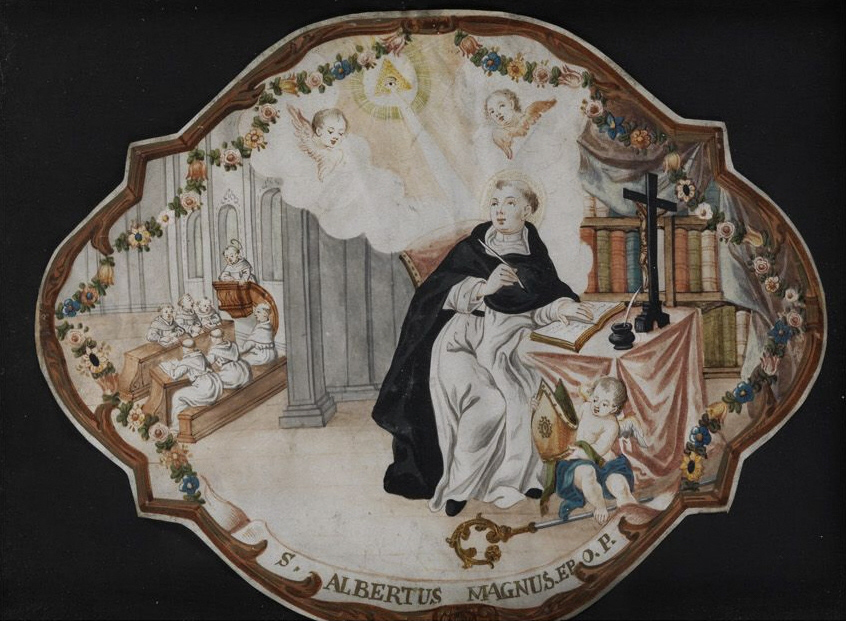
St. Albert the Great takes something of a middle route in response to this question. With St. Thomas, he says that the answer is uncertain: “In this question the solution is uncertain” (III Sent. , d.20, a.4, Borgn. 28, 361b). He also agrees with the reason for its uncertainty: “About this question, nothing of the truth can be known except from revelation” (Quaestio de conceptione Christi a.4, Colon. 263). But he does think we can give something of a probable opinion, and his own agrees with Scotus: “But as much as we are able to give an opinion, I believe that the Son of God would have been made man, even if [man] had never sinned” (III Sent., ibid.). And, “Yet it seems to me that this is more true, that [Christ] would have been made incarnate, even if man had not sinned.”
Interestingly, St. Albert attributes his opinion to the fact that it “concords more to the piety of faith” (ibid.) than the alternative. One of his responses to an objection seems to elaborate this position. The objection asks: “For what was [Christ] made incarnate?” If man had not fallen, it asserts, we would have no need of a teacher, a liberator, or a redeemer. So, if man had not fallen, there would apparently have been no reason that would have “excited” God’s charity. St. Albert gives a simple and beautiful reply: “[Christ] was made incarnate for demonstrating his extraordinary love, and so that he might prepare multitudinous delights for man, when he contemplates that brother who has the God of the universe in the flesh (incarnatus fuisset ad ostensionem eximii amoris sui, et ut multiplices delicias praeparet homini, cum contemplaretur eum in carne fratrem, whem havet universitatis Deum)” (ibid.). In essence, the primary reason why God became man is to show his great love, which he would have done whether or not man had sinned.
Elsewhere, St. Albert expounds upon the same text that the sed contra of St. Thomas’s article on the same question appeals to, Luke 19:10: “For the Son of man came to seek and to save the lost.” This text seems to suggest that the reason for Christ’s coming into the world is that man was lost and in need of a savior. But St. Albert makes a distinction: “The causing of coming into the world, and the cause of coming into this world, are different. The cause of coming into the world is the love of men and the unibility of human nature [to the Divine Nature]; but the cause of coming into this world is redemption from sin through passion and death. [The gloss upon the above verse] touches only why he came as redeemer, and not why he came simpliciter” (De conceptione, ibid.). That is, God had reasons to become incarnate simpliciter, in any world (any world with humans, at least), irrespective of man’s fallen status. But since man actually fell in this world, God’s actual, specific reasons to become incarnate in this world include saving man from sin.
St. Albert does indicate that if man had not sinned, even though God would still have become incarnate, he would not have suffered and died: “And although perhaps the incarnation of Christ is not a [mere] consequence of sin, yet the mighty works of redemption through his labor, passion, and death did follow from sin” (III Sent, ibid.). And “If the incarnation of Christ followed [sin], I do not know: but this is certain, that redemption through death did follow [sin]” (ibid.). Thus “the work of the incarnation is ordered to the work of redemption in [Christ’s] coming in this world . . . but he would have come simpliciter, were there not such order” (De conceptione, ibid.). In sum: God became man out of his great love. In this world, where man fell, that great love is manifested precisely in the redemption of man; but if man had not fallen, the same love would have still been manifested via an incarnation. I have thoughts about what St. Thomas would say in response to this position, but I’ll save those for another time.


Leave a Reply